Profiles
Profile 0.2.0 is the six-field default. Profile 0.3.0 is the selectable Reduced Metadata profile. Historical profile 0.1.0 is packaged for compatibility.
PROJECT CASE STUDY
A repeatable local checkpoint for processed proteomics CSVs before further analysis or data handoff
proteomics-csv-validation is a local Python system for structural and technical review of processed-sample proteomics CSV files. The browser application is the primary human-facing workflow; the CLI supports direct, reproducible command-line use.
I independently designed and built the system during an eight-week graduate capstone that reached version 0.5.0. Version 0.5.1 is the post-capstone open-source successor, with Apache License 2.0 and software citation metadata. Validation logic and bundled validation profiles are unchanged from v0.5.0.
01 / PRODUCT
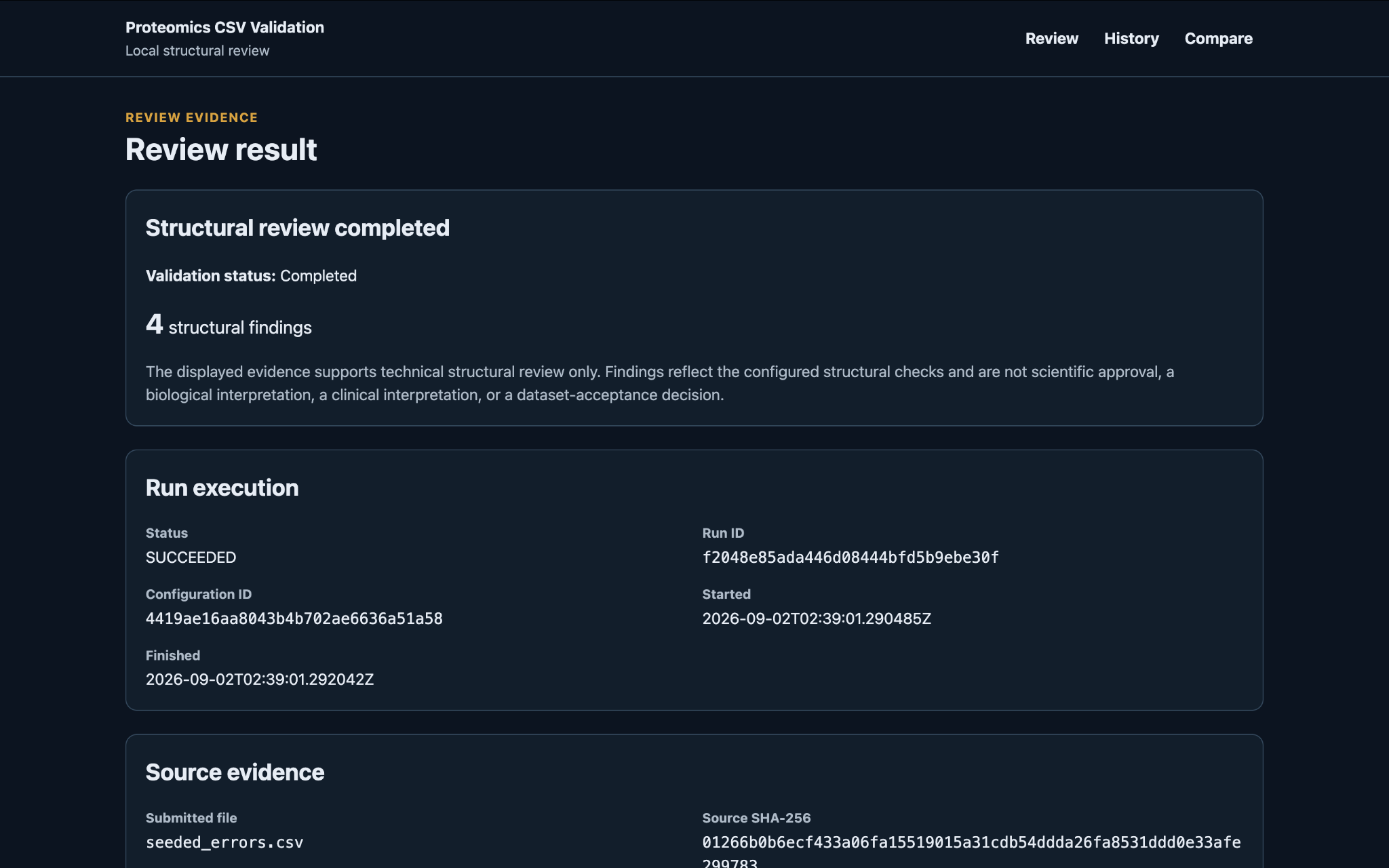
Version 0.5.0 adds a local review workflow to the structural validator. Reviewers submit a compatible CSV, inspect run details and findings, reopen prior runs through History, compare compatible runs deterministically, and export the exact stored Result Bundle.
Why I built the workflow this way. I designed the workflow to preserve the submitted source, define review rules explicitly, and store a durable record that reviewers can reopen, compare, and export without rerunning validation.
Finding counts summarize conditions detected by the configured structural rules. They are not quality scores. Scientific validity, biological interpretation, experimental quality, repository acceptance, and clinical validity require separate evaluation.
02 / WORKFLOW
Submit a compatible CSV under the selected profile and mapping mode.
Inspect run identity, source details, configuration, summary counts, individual findings, and Result Bundle contents.
Reopen completed prior runs from saved local History.
Compare compatible prior runs using right-minus-left descriptive deltas.
Export the stored Result Bundle byte-for-byte without rerunning validation.
The CLI is supported alongside the browser workflow. proteomics-csv-validate is available for reproducible command-line review, automation, and package-level verification.
03 / REVIEW MODEL
Profile 0.2.0 is the six-field default. Profile 0.3.0 is the selectable Reduced Metadata profile. Historical profile 0.1.0 is packaged for compatibility.
The system supports strict, automatic, and explicit mapping modes. Mapping resolves recognized source headers to canonical field names, while profile selection is separate.
Schema, identifier, and required-value missingness checks handle distinct structural conditions, avoiding duplicate classification.
Descriptor Schema
1.0.0
Mapping Specification
1.0.0
Missingness Rulemissingness.required_value 1.0.0
Application Version
0.5.1
04 / ARCHITECTURE
SQLite stores run and configuration state plus records for stored Result Bundles. The Result Bundle files are stored on the filesystem. Before a stored result is reopened or exported, the application checks that the database record and file still agree.
The base CLI uses only the Python standard library at runtime. Browser dependencies are isolated in the web extra.
Core reviewer tasks use server-rendered HTML/CSS and function without JavaScript.
If stored data is corrupted or no longer matches its record, the application reports an integrity failure instead of trusting the result.
Web Extra
FastAPI 0.141.1 · Uvicorn 0.52.4 · Jinja2 3.1.6 · python-multipart 0.0.32
Persistence
stdlib sqlite3 · explicit migrations · WAL
Request Safeguards
HMAC-based cross-site request forgery (CSRF) protection · same-origin checks · trusted hosts · bounded multipart handling
Filesystem Safeguards
filename sanitization · application-owned staging · security headers
05 / APPEARANCE
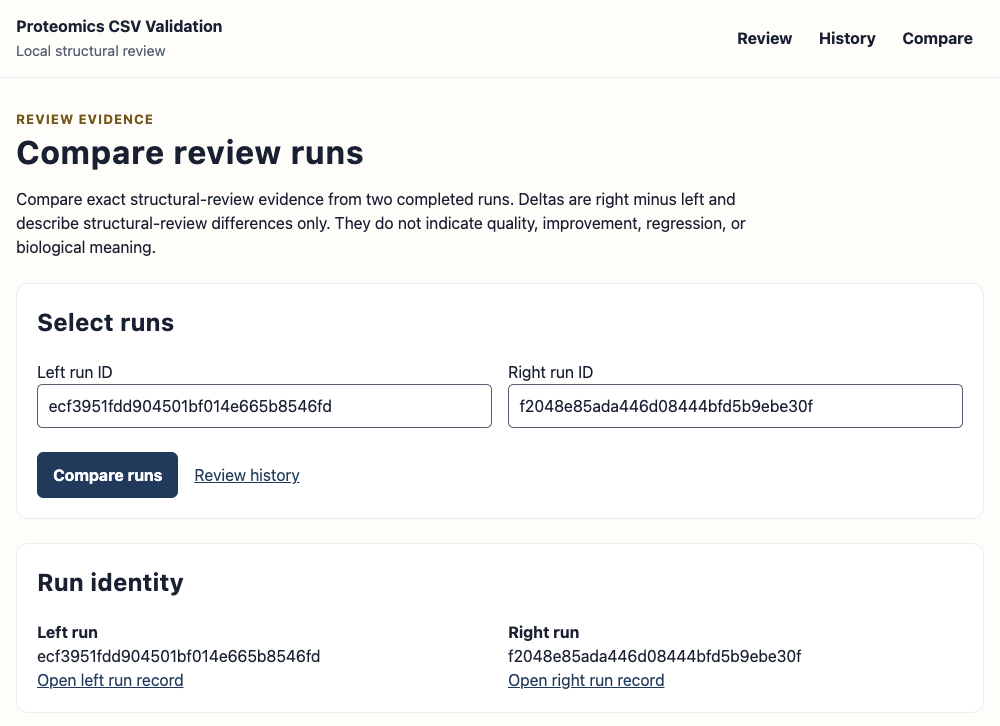
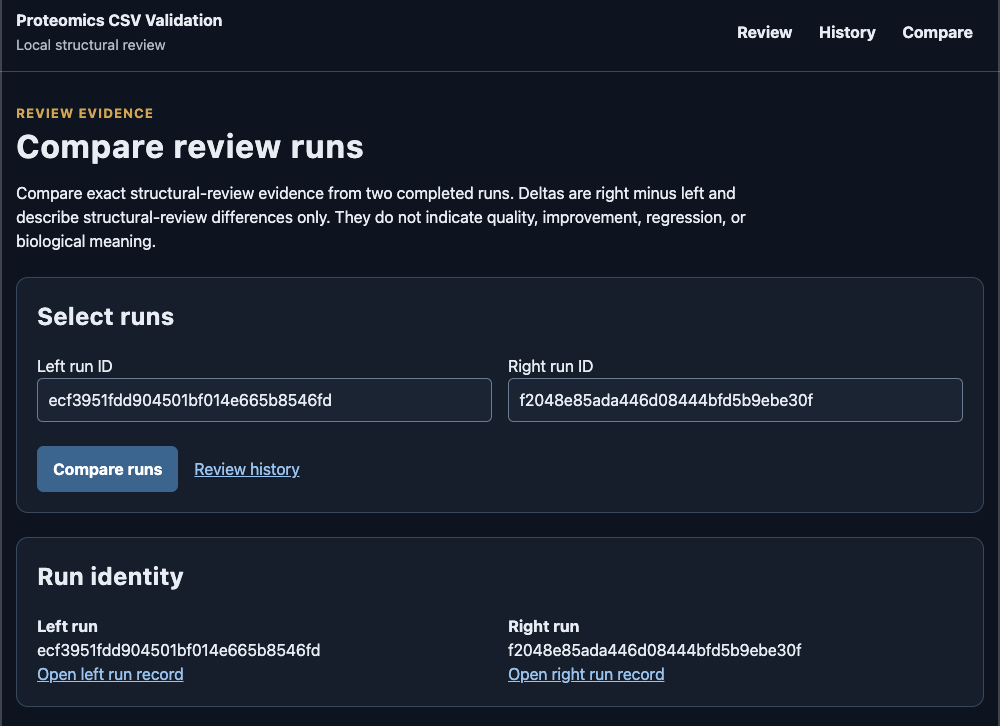
The application follows the operating system's appearance preference. The paired screenshots show the same Compare state in light and dark modes.
06 / COMPARE
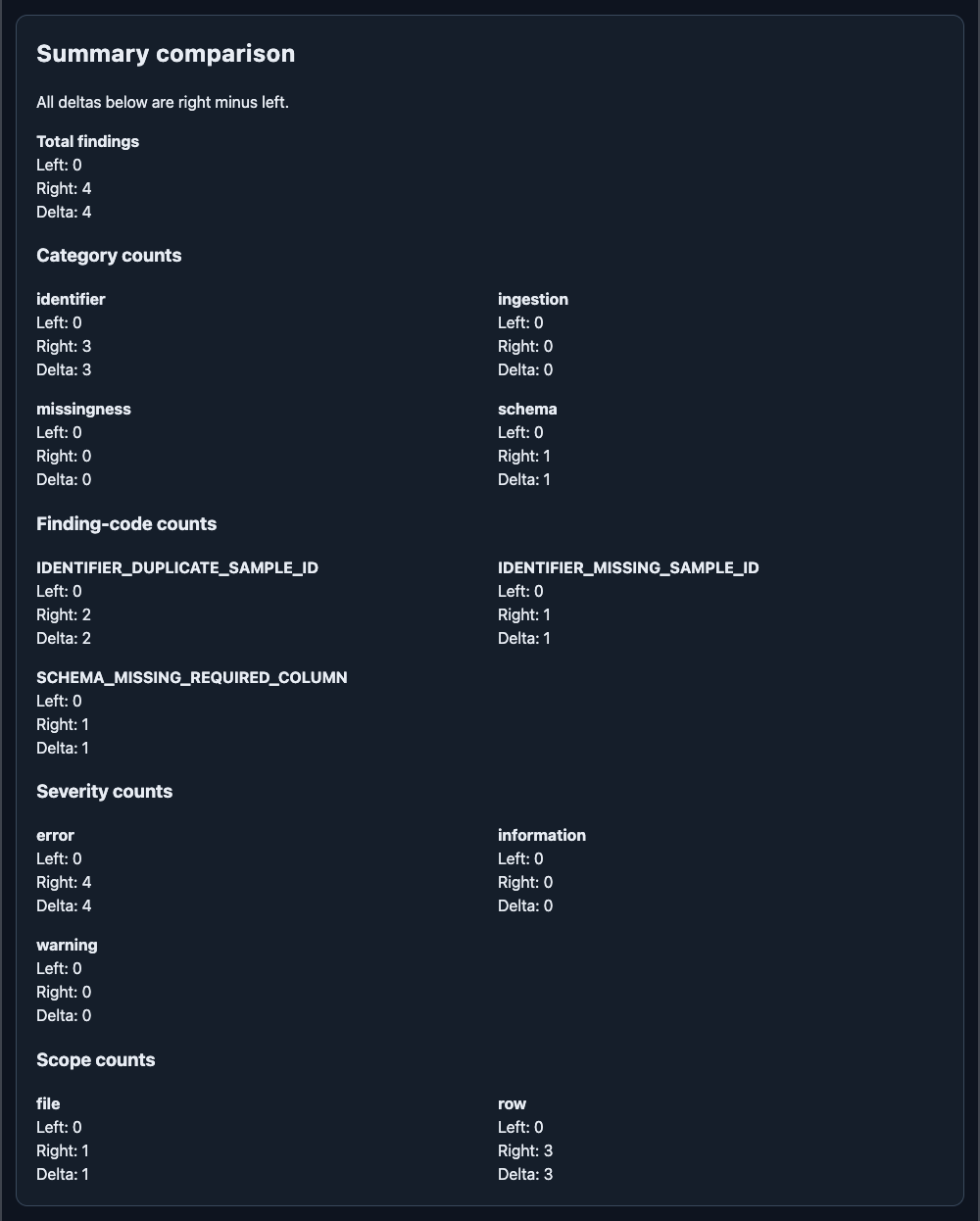
Compare reports exact structural differences between compatible completed runs, with deltas calculated as right minus left.
The deltas describe structural differences only; they do not indicate quality, improvement, regression, or biological meaning.
07 / TESTING & EVALUATION
The v0.5.1 regression suite contains 342 passing tests.
At the v0.5.0 capstone endpoint, a separate public-data structural evaluation used 42 processed-sample records derived from PXD060583. The evaluation covered the selected profiles, mappings, structural rules, and derivation only.
The final v0.5.0 hosted CI run completed six platform/interpreter test jobs plus one release-artifact build job.
The immutable v0.5.1 release publishes the wheel, source distribution, and SHA-256 checksum record. Public assets were downloaded and rehashed after publication.
Three controlled synthetic fixtures established exact known outcomes: a zero-finding baseline, four seeded schema/identifier findings, and three required-value missingness findings.
Historical v0.2.0 system testing ran a 12-case compatible-input matrix twice across six hosted environments, for 144 successful executions. A Windows path assumption in the test harness was corrected without changing application behavior.
Historical v0.2.0 installed-command timing used five warm-ups and 30 measured runs at each of 1,000, 10,000, and 100,000 rows, for 90 observations on an Apple M1 workstation under local single-process execution.
Historical v0.2.0 · Apple M1 · 90 measured observations
Median latency with interquartile range (IQR). Bar lengths show relative median latency within this recorded protocol.
Exact values and variability are shown above. The bars provide a within-protocol visual comparison only.
A separate local load and concurrency test completed 500 sequential executions at 100,000 rows and 150 executions across concurrency levels 1, 2, 4, and 8 with zero failures and zero normalized-result mismatches.
These measurements apply only to the documented local conditions and should not be treated as production-capacity benchmarks or generalized to other hardware.
The final v0.4.0 usability evaluation involved two independent technically literate reviewers completing eight predefined tasks each. All 16 answers matched the predefined scoring key without substantive facilitator assistance.
These results reflect two participants; broader usability conclusions would require a larger predefined study.
Version 0.5.0 was rebuilt from the release source revision, installed as a wheel under Python 3.11 and 3.14, checked against its release asset hashes, and published as an immutable GitHub release. The release and all three asset attestations were verified.
08 / RELEASE PROGRESSION
Initial local validation workflow
Required-value missingness
Automatic and explicit header mapping
Reduced Metadata profile at the release checkpoint
Browser review, History, Compare, and exact Export
Post-capstone open-source release with Apache-2.0 and software citation metadata
During development, I evaluated scikit-learn, Pyteomics, pyOpenMS, pymzQC, SDRF tooling, HTMX, and Playwright. The evaluations informed scope decisions; none of those tools are package dependencies in v0.5.1.
09 / FUTURE DIRECTIONS
Evaluate SDRF-Proteomics, PSI controlled-vocabulary alignment, mzQC exchange, and mzML-linked metadata workflows using tools such as sdrf-pipelines, pymzQC, Pyteomics, or pyOpenMS. Separate development research examined public DDA/LFQ, TMT, DIA, and mzML/QC datasets to test interoperability assumptions and future QC directions; these were distinct from the v0.5.0 PXD060583 processed-CSV evaluation.
SDRF conformity, repository-submission readiness, and raw LC-MS processing are outside the current system's scope.Explore numeric syntax, controlled vocabularies, batch/group summaries, profile-specific ranges, richer profiles, and predefined outlier or cohort checks.
Structural outlier flags would require separate biological interpretation and would not trigger automatic correction.Study scikit-learn-backed review prioritization or unusual-pattern detection as an adjunct to deterministic findings.
Any model would require defined training data, leakage-controlled evaluation, predefined metrics, baseline comparisons, reproducibility and privacy controls, and human review.Broaden independent reviewers and public datasets, then measure memory, cold/warm execution, sustained runs, concurrency, recovery timing, and additional physical hardware.
Broader claims would require broader evaluation.Research-object packaging such as RO-Crate could be evaluated for a defined multi-artifact archival use case. A hosted service would require a separate architecture for authentication, authorization, storage, monitoring, backup and recovery, incident handling, and threat modeling.
10 / SCOPE
11 / RESOURCES